Having spent 14 wonderful years in Honolulu, all I can say is I am saddened that the Hawai'i GOP found this speech, posted below, so repulsive that it booted Rep. Beth Fukumoto, who represents House District 36, out of her leadership position in the Hawai'i House of Representatives. Hawai'i is a deeply "blue" state (I suppose being surrounded by ocean, what would you expect?) and with the GOP engaging in circular firing squad tactics, it will likely get even bluer (last I heard, there was not a single Republican in the State Senate). Rep. Fukumoto may ditch her party.
My own state senator was Sam Slom, a Republican and had formed or led several Hawai'i small business organizations. He lived down the street from me in Kalama Valley on Oahu and we would sometimes shoot the shit informally as I would ride my bike past his house on the way into or out of our little valley. We sometimes disagreed, but we were never disagreeable. Aloha spirit and all that.
This continued increase in toxicity of the political process saddens me.That it is corroding away that Aloha Spirit brings tears to my eyes.
Saturday, February 18, 2017

Tuesday, February 14, 2017
Gun Laws and Statistics: A Sometimes Toxic Mix
In a society where guns are highly prevalent and the right to own them
is constitutionally protected, solving a public health crisis that
claims 35,000 lives every year (two-thirds by their own hand) is like a
jigsaw puzzle. There are many causes of the problem, and many parts to
an effective solution.
--Dr. Jeffrey Swanson, Professor, Duke Univ. School of Medicine, in a recent opinion piece
Elena Giorgi states the oft-repeated claim that "states that have closed the loopholes have seen a huge reduction in gun homicide." I wish Ms. Giorgi and others would cite their sources for these claims because as far as I know, there is no evidence of such a huge cause and effect between closing private sales "gun show loopholes" and seeing resulting "huge" reductions in gun crime (the sometimes cited Connecticut case involved initiating both a Permit to Purchase system and background checks, not just a private background check law). Indeed, states with so-called "weak" gun laws range from those with very high gun homicide statistics to some having the lowest gun homicide rates . Indeed, one can look closer to home. The New Mexico State Constitution pre-empts local government from passing gun laws, so every county has the same laws. Do we all have the same gun violence rates? I don't think anyone would mistake peaceful Los Alamos for some of the gunshot-ravaged parts of Albuquerque. The same vasts differences in gun violence rates exist in different districts of Chicago, as seen in the figure below. Suggesting to readers that should we pass this bill, there will be a spectacular reduction in gun crime in New Mexico is misleading and avoids the question of why gun violence is so localized even when laws are not.
 |
| Homicide by police district, from Wikipedia |
As far as cause and effect, the only good study I know of that tried to model a "before and after" cause/effect relationship was a paper out of the Hopkins group (Kara Rudolph et al, 2015) that modeled (not proved) that the CT Permit to Purchase law implemented by Connecticut in 1995 was causatively associated with a much steeper (~40% over ten years) drop in gun homicides than was seen in CT in non-gun homicides over the same interval or when compared to gun homicides over that same interval in several control states that did not have or implement similar laws. It is a good paper in part because the authors are very careful to identify and discuss all their assumptions and try to work in meaningful controls, which is a vexing problem in this field. But the CT case involved a rigorous permit to own/purchase a handgun law combined with background checks, not a background check law alone.
Indeed, a recent so-called study put out by the Center for American Progress (CAP), a political advocacy organization, that purported to show that strong gun laws correlate with reduced gun violence was almost entirely explained by the relationship between gun controls, gun ownership rates, and gun suicide rates. There was a correlation, albeit a weak one, between "strong gun laws" and reduced domestic homicides and some other types of homicides but overall, gun homicide rates did not correlate with the CAP's highly subjective evaluation of state gun laws. And as any statistician can attest, correlation is not perforce causation. I suspect this may be the source that some use to attribute magical powers to background check laws.
But lets not throw the baby out with the bathwater. The value of a comprehensive background check law, should it be passed, is that it would likely make it more difficult for a prohibited person to acquire a gun via the private market, although not all NICS denials are due to truly scary people being denied a gun**. But catching bad guys is a good thing, because it cuts off one conduit for bad guys getting guns. But New Mexico has some of the highest vehicle and residential burglary rates in the US and many firearms on the illicit market are likely stolen (based on a conversation I had with Albuquerque Police Chief Gordon Eden), and recycled through the black market. Clamping down on the ease of stealing firearms is an important task in reducing gun violence. Perhaps the Legislature should give tax rebates to those who buy robust gun safes. So is reaching out to at risk groups and convincing them that gunshots are not an acceptable form of conflict resolution. New Mexicans To Prevent Gun Violence works tirelessly at this last task but seems to be brushed aside in favor of listening to high profile advocacy groups. Frankly, Nevada had it right before Everytown totally goofed things up with their new initiative (which cannot be implemented as written). Background checks for person to person sales were free and voluntary.
** from a Washington Post blog article: "... “The (ATF) special agents we spoke with generally commented that they do not consider the vast majority of NICS referral subjects a danger to the public because the prohibiting factors are often minor or based on incidents that occurred many years in the past,” the report added. The report cited, as examples of people prohibited from buying gun, someone who had stolen four hubcaps and a person convicted in 1941 of stealing a pig. Of the cases reviewed by the IG, 48 percent of the crimes had occurred more than five years earlier — and 13 percent at least 20 years previously."
As I have said before in the Daily Post, the original House Bill 50 and its companion Senate bill would likely (and certainly did) create a firestorm of resistance among law abiding gun owners because the provisions in the bill put onerous constraints on temporary transfers and casual sales between law abiding people who know and can vet each other without government oversight. If we expect any sort of bipartisan support for this bill, and for the Governor to sign it, some "common sense" exemptions to the background check provisions will be needed. I testified in support of a scaled-back bill but the current one has several issues that make it problematic, such as the five day limit on temporary transfers. Imagine being stuck in a snowstorm while on travel and coming back to potential misdemeanor charges because your three day "temporary transfer" turned into a week! Likewise, the needless hassles this bill would put on law abiding rural New Mexicans who might only want to sell or lend a gun to a neighboring rancher they have known, and trusted, for their whole life but who have to drive fifty miles to find a licensed dealer makes sense only if you assume all gun owners are potential prohibited persons.
Finally, the relationship between gun laws and gun crime is in need of more high quality scholarship, not more advocacy-research. As Prof. Daniel Webster (Center for Gun Policy and Research, Bloomberg School of Public Health, Johns Hopkins University) and Dr. Garen Wintemute (Violence Prevention Research Program; Department of Emergency Medicine; University of California, Davis) recently stated in a review paper of gun law effectiveness (Annu. Rev. Public Health 2015.36:21-37), "...Mounting evidence indicates that certain laws intended to increase the accountability of firearm sellers to avoid risky transfers of firearms are effective in curtailing the diversion of guns to criminals,in particular the more rigorous Permit to Purchase handgun laws, comprehensive background checks, strong regulation and oversight of gun dealers, and laws requiring gun owners to promptly report lost or stolen firearms. Evidence that lower levels of guns being diverted to criminals will translate into less gun violence is less robust..."
So lets have the discussion of this bill, and let's support, wholeheartedly, the notion that we should have an effective mechanism to vet a stranger before handing over a firearm. I think a highly modified version of the pre-filed bills could become law and could make incremental but measurable reductions in gun violence while not making life miserable for law abiding citizens. That's the discussion we should be having.
The bigger picture of gun violence in New Mexico will depend on a lot more variables being addressed than requiring background checks for private gun sales. There is no silver bullet here, just a lot of copper and lead ones that we need to aim carefully if we are to hit the target of gun violence reduction.
More reading: There’s More To Reducing Gun Violence Than Expanding Background Checks.
Gaps continue in firearm surveillance: Evidenc from a large U.S. City Bureau of Police
Sunday, January 29, 2017
Marching for Life Is Not Enough
Michael Brown spends much of his polemic comparing the peaceful and positive nature of the March for Life to the sometimes rowdy and occasionally rude Women's March. I am relieved, however, that "...there will be no calls to burn down or blow up abortion clinics.." and thus Brown and his colleagues repudiate the bombing of abortion clinics or executions of abortion providers. But even if he promises a peaceful resistance against abortions, it takes more than marching around, writing letters to the editor, or having Catholic priests tell us how to vote in Presidential elections to reduce the demand for abortions in America. If history tells us anything, merely passing laws doesn't help either. It takes, as the other side likes to say, the ability to make better choices and that usually means having a supportive community to count on.
For me, its been long way and many decades from Buffalo, NY to Los Alamos, NM but for some of us who hail from that neck of the woods, the name Nelson Henry Baker comes to mind. Nelson Baker was a Civil War veteran who returned home to Buffalo to set up a profitable business. He later had a calling and joined the priesthood. Using his own resources and those he raised through fundraising efforts, Father Baker created "The Association of Our Lady of Victory" city of charity in Lackawanna, NY, which is a city on the south side of Buffalo. That city of charity included a minor basilica, an infant home, a home for unwed mothers, a boys' orphanage, a boys’ protectory, a hospital, a nurses' home, and a grade and high school.
I know a little about that history because that is where my mom, who found herself pregnant with me and abandoned by her lover, stayed in the fall and winter of 1953. I was born in Our Lady of Victory Hospital as the page turned to 1954. It was through the generosity and vision of Father Baker and the city of charity staff that my mom had a refuge from a critical world, through the support of my maternal grandmother, who moved in with my mom after I was born to take care of me while my mom went back to working two jobs, and of course to my mom's own indomitable spirit and belief in the sanctity of life that I am here to write about it.
So, Mr. Brown. If you don't like abortions, put your money where your marching shoes are. Folks like my mom will thank you. Political grandstanding alone doesn't solve anything.
Monday, January 16, 2017
Heteronormatives, Cisnormatives, and Basketfuls of Deplorables
Editor, Santa Fe New Mexican
I wonder if Progressives in places like Santa Fe recall Bill Maher's criticism of people living inside their own bubbles. The City Council's recent tie vote is a big relief, i.e., that we did not actually approve this offensive and largely symbolic resolution, which includes words that most working class people formerly known as Democrats probably never heard or saw.
If I had my wish, it would be that rather than writing resolutions vetted only by those inside the bubble, we concentrate on running the city well and winning some elections. In case anyone missed it, we Donks (i.e., Democrats) lost the White House (not to mention Congress) because Donks in many Rust Belt areas such as the one I grew up in either stayed home or abandoned their party standard bearer. We need to get those folks back. Even heteronormatives, cisnormatives, or basketfuls of deplorables. Whatever those descriptors mean.

Saturday, November 19, 2016
Is Everytown About to Target Law Abiding Gun Owners in New Mexico?

“…The seeming inanity of the D.C. law* is all too common in the gun rights debate more generally. Gun control advocates seem ever willing to adopt any gun regulation no matter how unlikely the law is to actually accomplish its objectives….the National Rifle Association, Gun Owners of America, and other gun rights groups oppose closing the secondary market loophole. Their position seems to be “Let’s keep guns out of the hands of criminals, just don’t pass any laws that make it harder for criminals to get their hands on guns.” Welcome to the great American gun debate….” -UCLA Constitutional Law Professor Adam Winkler, in "Heller's Catch-22"
* overturned by SCOTUS in District of Columbia v Heller
On a 9 November entry on its web site, Moms Demand Action states "Everytown and New Mexico Moms Demand Action Declare Victory in Creating Bipartisan Background Check Majority in State Legislature", specifically calling out legislators Nate Gentry (R), Bill Soules (D), Liz Stefanics (D) and Elizabeth Thomson (D). We can therefore expect that at minimum, a background check bill will be introduced by the Democratic majorities in both houses.
The purpose of a background check is difficult to argue against, i.e., we all have a moral and legal obligation to not transfer firearms to prohibited persons, i.e. those with a felony, legal finding of mental defect, protective order, or other disqualifications on their record. Hence, polls repeatedly show majorities, even majorities of gun owners, support them in principle. A straightforward bill that facilitated background checks for gun owners transferring weapons via the secondary (i.e, private sales) market to those whom they cannot personally (and, perhaps, in a legally binding manner) vouch for in high confidence is a good idea, as long as the State ensures these can be done without due financial or time burdens on gun owners. Indeed, it would be reasonable to provide tax rebates or other incentives to pay for these as the government provides for other actions (such as green energy, bicycle commuter, home mortgage, and other tax credits) it wishes to encourage for the public good.
Where Everytown runs into trouble is when it tries to hide onerous gun controls in the guise of background checks. The recent Everytown endorsed ballot questions in Nevada (where it barely passed) and Maine (where it was defeated) are examples of gun control overreach that spell doom for any cooperation between law abiding gun owners and gun violence prevention organizations.
Buried in the ballot questions in both NV and ME were toxic "temporary transfer" prohibitions that would criminalize many normal, safe, and legal activities that gunsport enthusiasts take for granted. Any transfer not explicitly listed as exempt is illegal unless a gun owner legally transferred title of a gun to another person at a licensed dealer (FFL). So, the following would be illegal without literally transferring ownership via an FFL because Everytown makes no distinction between temporary transfers between long term gunsport buddies and putting a gun for sale on something like Gunbroker.com:
• Letting a buddy handle and shoot your firearm anywhere but at a designated shooting range unless you are in that person's actual presence (better not duck off to "water a tree" unless that tree is close by).
• Leaving a gun with a friend who does light gunsmithing, adds accessories, or has the tools to do repairs and upgrades.
• Loaning a pistol to a friend unless the friend is in imminent jeopardy, i.e., "...an immediate and significant threat of serious harm to human well-being".
• Storing your firearms in a friend's safe while out of town.
• Loaning a friend a gun for a hunting trip unless you are in proximity to the borrower.
• Storing firearms for a friend who may be temporarily despondent due to personal hardship (unless you can legally demonstrate it is "only as long as necessary to prevent such imminent death or great bodily harm"). Recall that about two thirds of all gun deaths in the US are suicides.
12 of the 16 sheriffs in Maine and 16 of 17 in Nevada opposed these ballot initiatives. Further, enforcement would be a nightmare or downright impossible unless guns are registered to owners. Would that be the next step and if so, it needs discussion. So it is extremely important for the gun owning community to examine, as soon as possible, any bills prefiled or introduced during this legislative session, read the fine print, and call your representatives with input.
The gun owning community should endorse reasonable actions that reduce gun violence. A straightforward law that mandated background checks for transfers to someone you cannot, in good faith, legally vouch for, or for permanent transfers between most buyers and sellers (with exceptions for family members and long term close friends, etc) is a good idea. For example, I could, in high confidence, transfer a firearm to someone I know who goes through the same Federal investigative hoops I go through, without fear of any surprises.
Likewise, the gun violence prevention community must not destroy the required trust needed to reach common ground. Indeed, if the gun violence prevention community would spend more time studying gun culture (for example, as studied by sociologist David Yamane of Wake Forest University), some of the colossal misreadings of gun enthusiast's motives and activities that lead organizations like Everytown to support bad legislation could be avoided.
Published in edited form in the Santa Fe New Mexican and Los Alamos Daily Post.
NOTE: As reported in the Santa Fe New Mexican, the background check bill described above has been introduced as SB 48 and HB 50.
Saturday, November 5, 2016
Trying to Dissect the Center for American Progress Gun Report (America Under Fire)
The Center for American Progress, a progressive and liberal think tank, recently released a report "America Under Fire" that claimed a strong correlation between state gun law strength and reduced levels of gun violence. Their main correlation chart is shown below. To get this chart, CAP researchers tallied up ten variables on gun violence, took the average, and plotted it against gun law strength (an admittedly qualitative and subjective measure) as defined by the Law Center to Prevent Gun Violence.
From what I can tell so far, most of this correlation can be traced to two variables, suicides and gun traces to where crime guns were originally sold. The rest of the correlations are very low in significance.
The ten variables used by CAP are:
Rate of overall gun deaths per every 100,000 people, 2005-2014
Rate of gun suicides per every 100,000 people, 2005-2014
Rate of gun homicides per every 100,000 people, 2005-2014
Rate of fatal gun accidents per every 1 million people, 2005-2014
Rate of mass shootings per every 1 million people, 2006-2015
Rate of intimate partner gun homicides of women per every 1 million women, 2005-2014
Rate of gun deaths among people younger than age 21 per every 100,000 people younger than age 21, 2005-2014
Rate of law enforcement officers feloniously killed with a firearm per every 1 million people, 2005-2014
Rate of fatal shootings by police per every 1 million people, 2015-2016
Crime gun export rates per every 100,000 people, 2010-2015
Here is their chart, widely reported in the popular press,
 |
| For starters, the linear correlation is a piss poor fit to the data points |
I had several problems with this study. First, the report had a very thin section on methodology. If one looks at the ten variables, one sees they vary widely in frequency from several parts per hundred thousand (suicides range from about 14 to 2 per 100,000 population in various states and homicides from about 10 to 0.5) while other categories are measured in less than a part per million (mass shootings) so may occur rarely. Police shootings were only reported for one year. It would appear to me that all of these variables are weighted equally even when they are rare or poorly known events and this is done for subjective and politicized reasons. We know that gun crime and violence are not homogeneous on the state level. Illinois, for example, has a few homicides per 100k but some parts of Chicago have rates, given current trends, likely exceeding an order of magnitude higher than that while other parts have rates approaching zero (see figure). Crime must be looked at on a scale defined by the problem, not by arbitrary units convenient to advocates. Finally, the authors give lip service to correlation not being causation but nonetheless implicitly state that it is by basing recommendations for gun control on their study.
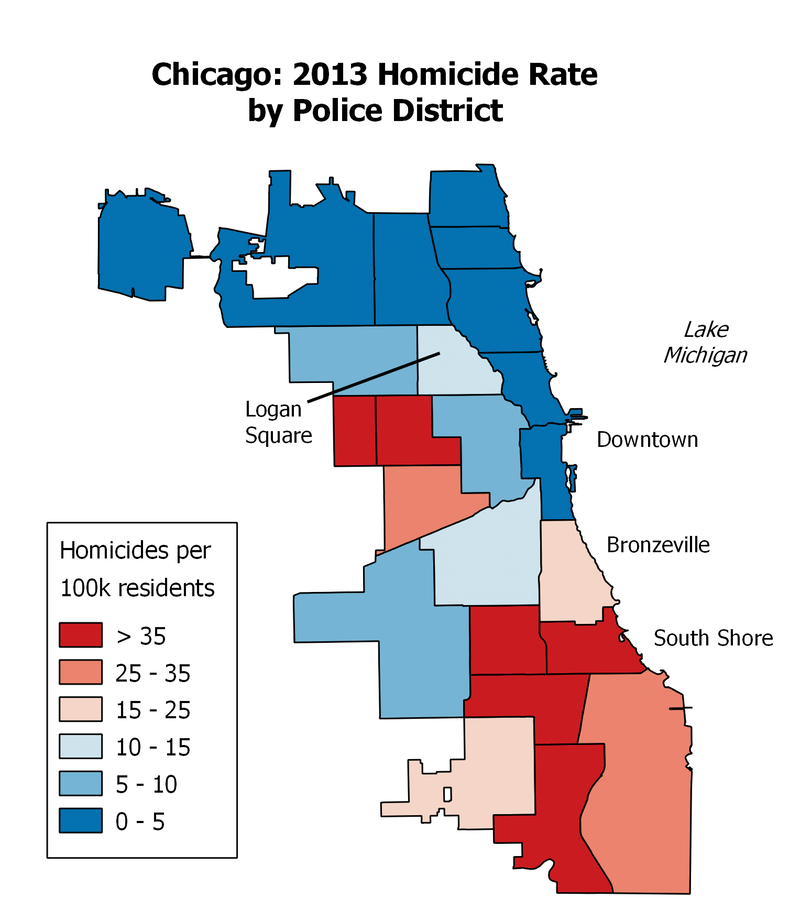 |
| Homicide by police district, from Wikipedia |
So with these caveats, I tried to look at simpler questions in the CAP study to see if strong gun laws make us safer. Here are some charts. Click on them to see in full scale. To make these, I used the fatality rates in the CAP report, converted the Smart Gun Laws rankings of A to F (where F is a weak set of laws and A is a strong set, obviously subjective and defined by a gun control advocacy organization) to a zero to 4 ranking on a plus vs. minus scale, i.e. A- = 3.7, B+ = 3.3, etc, and used a Kalesan study of gun ownership as reported in Business Insider for gun ownership rates.
Looking at homicides, homicides show no correlation with Smart Gun Law rankings or frequency of gun ownership (data taken from the CAP report except where otherwise noted). I'm not surprised at the lack of a gun correlation because with over 300 million guns in America and about 10000 gun homicides per year (round numbers), one would expect about one in 30,000 guns to be used in a homicide if each gun only caused one homicide. Such small numbers are lost in the weeds. The lack of a correlation with gun law strictness (as defined by LCPGV) suggests these laws are ineffective at curbing gun homicide. Further, one would surmise that restrictive gun laws might stop criminals from buying guns on the legitimate market but as I recently posted on this blog, a survey of jailed criminals, when asked in a recent study, said they obtained guns on the black market or stole them.
 |
| Law Center gun law strictness ranking vs homicide rate |
 |
| Gun ownership in a state vs. homicide rate |
Looking at gun ownership and laws, one sees less gun ownership in states with strong gun laws. Not sure this means people are deterred from buying guns by the hassle and red tape of gun laws or if it is easier to pass onerous gun laws in states where fewer own guns. New York State, for example.
 |
| Law Center To Prevent Gun Violence rankings vs. gun ownership |
There is a correlation between suicide rate and gun ownership and therefore, restrictive gun laws. Suicide by gun is pretty much guaranteed, so if one is suicidal and armed, there is a pretty good chance of success should the urge overwhelm someone. As Dr. Dan Nolan said on Guns.com, there are states like Alaska where gun ownership is high but so are factors contributing to suicide (seasonal affective disorder and a strong asymmetry of male vs. female population) so the tendency to suicide may be high and there is a gun present to get it done. But clearly gun ownership does not control suicide as Alaska and Hawaii have high ownership rates (62 and 45 percent, respectively) and differ by close to an order of magnitude in suicide rate (14 and 2 per 100k population, respectively). For that matter, Japan's suicide rate is 50% higher than ours in the U.S. in a virtually gun-free society. I don't know much about Alaska but worked in Honolulu for 14 years. Hawaii has its social ills but also has a strong sense of ohana which may give people in despair resources other than a bullet to the brain, thus ohana, as well as a latitude at the tropics rather than nearer the North Pole and thus without huge seasonal swings in daylight, may have more control over suicides than gun availability.
 |
| Gun ownership per state vs. suicide |
As far as other variables, I have not looked at all of them but did some preliminary calculations on how one could come up with a strong correlation by lumping all these variables together, since one is counting the same thing over again in some cases (total gun deaths, suicides and homicides) and weighting extremely rare events equally with more common ones. For example, there is a low correlation between gun ownership and domestic homicide of women.
 |
| Gun ownership vs. domestic homicides |
But if we count homicides and domestic homicides of women per 100,000 we get no correlation as domestic homicide of women is a rarer event compared to homicide.
 |
| homicides plus domestic homicides,both per 100k, vs. gun ownership in a state |
If we weight domestic homicides by 10x as the study authors may have done, i.e., add domestic violence of women gun homicide in parts per million as an equal variable to homicides in parts per 100k and add suicides, we get this, which is a correlation approaching that reported by CAP.
 |
| Combined fatality (homicides, 10x domestic homicide, plus suicide) vs gun law rank |
I think its worth continuing to try to figure out what CAP did but in spite of a request for information, it has not been forthcoming. I think CAP proved that strong gun laws are present in states with fewer guns and therefore fewer gun suicides. The study also confirmed that stronger gun laws don't prevent gun homicide, which could potentially be a good proxy for gun crime.
 |
| Unemployment v Suicide. From Huffington Post |
 |
| Guns in the US from Azreal et al, preprint (2016) |
Suicides are a major problem but a mental health, economic, and social problem, not a crime problem. Studies that purport to make Americans safer from gun violence need to point out the difference and direct crime reduction at crime and suicide reduction at suicide. Furthermore, cutting edge work by Andrew Papachristos and other sociologists gives us a better idea of who is committing violent crime and why. As Professor Papachristos' web site tells us, "...Most recently, Papachristos was awarded an NSF Early CAREER award to
examine how violence spreads through high-risk social networks in four
cities. He is also currently involved in the evaluation and
implementation of several violence reduction strategies, most notably
the Project Safe Neighborhoods and the Group Violence Reduction Strategy
in Chicago..." Such studies and directed efforts, including the New Mexicans To Prevent Gun Violence work with youth in Santa Fe in pledging to renounce gun violence, need to be integrated into violence prevention strategies rather than simply looking at suspiciously defined correlation analysis that may tell us nothing about causation or prevention.
Added over the weekend. Here are some more plots out of the CAP report. Sources of data in are in the CAP report. Most of these correlations are quite weak.
 |
| Traces of crime guns to origin of sale |
 |
| Law Enforcement shootings of civilians |
 |
| Law enforcement officers killed in action |
 |
| CAP uses a USA Today source on mass shootings, in which 4 or more people are shot regardless of reason. So this conflates gang shootings, drug shootouts, family violence, and random acts |
 |
| I summed up all of the above variables to get this correlation. |
Anti
Trafficking laws aimed at so called gun exporting states (see graph above) are worth looking at if these are written wisely rather than with
the typical birdshot approach; the CAP report shows a strong
correlation between gun laws and sources of guns traced to crime. Maybe
there is room for compromise here in enacting a national standard for
gun sales tracking to cut down on trafficking. To some degree, the
paranoia on a national registry and tracking system is well deserved but
its not clear to me how one cuts down on illicit sales without some
ability to figure out how guns get from W. Virginia to New York. But
first we need a better estimation of how many guns are trafficked
between state lines vs. how many are stolen or acquired by other means.
Let's not have a solution in search of a problem.
But
some current "common sense laws" being proposed are nothing of the
sort. The Bloomberg-written ballot initiatives voted on in Maine
and Nevada could, with some provisions, increase gun violence. For
example, suicide is the major cause of gun deaths. Right now if a close
friend told me he was suicidal and asked me to lock up his guns, I could
do so. With the provisions of those initiatives, he would have to
legally transfer ownership of them to me via a Federally licensed gun
dealer (FFL) or it would be a criminal offense. Then, when his urge
passed, I would have to legally transfer the guns back to him at an FFL.
I suspect such provisions would strongly discourage such cooperative,
potentially life saving initiatives. Go figure. These are the sorts of
provisions offered by those who know little about the firearms community
that build walls rather than break them down.
Finally, from Dr. John Lott
More useful academic research follows states over time to see how rates of violence change with the adoption of different laws. These changes are then compared to the states that did not change their laws."
Sincerely,
John R. Lott, Jr., Ph.D.
President
Crime Prevention Research Center
Lott makes suggestions which are quite good but even comparative before/after studies are frought with difficulty as economic, social, and demographic changes are occurring, i.e., there is no real controlled experiment. As Lott would probably agree if I could ask him, there is no such thing as a properly controlled experiment as far as changes in law are concerned. Stay tuned.
Tuesday, November 1, 2016
Is Mr. Lucero a "Constitutional Sheriff"? Why not ask him?
Stephanie Nakhleh painted a grim picture of Sheriff Marco Lucero as being part of an anti-government "...dangerous group of radicals..." called the Constitutional Sheriffs and Peace Officers Association. Of course, most of what we learn from her letter is Ms. Nakhleh's opinion of CSPOA, and we learn even less about Sheriff Lucero other than that his name appears on several web sites. This tactic to discredit the man is a form of ad hominem attack referred to as the "bad company fallacy" and is reminiscent of McCarthyism. Perhaps instead of inferring the sheriff's politics, one should simply ask him. He lives here and has a phone number and email address. Not to mention, a stable on North Mesa.
As far as CSPOA, they do have a point, i.e., that there is a growing political movement that is asking whether the Federal government is overreaching its legitimate boundaries. An example of that philosophy in action was most recently seen when the Malheur Wildlife Refuge Liberation Front occupiers were exonerated, perhaps by jury nullification or at minimum, a realization that the charges were a legal stretch by the Feds. As Judge and Professor of Criminal Justice Steve Russell says in the links here, "... Take it from a judge that we have juries to protect us from both overbearing judges and crackpot legislators. When used in the limited circumstances that justify it, jury nullification is the conscience of the community. "
As far as CSPOA founder Richard Mack's philosophy of government? I don't know enough about it to comment fully, nor am I a fan, but in at least one instance, he and fellow Sheriff Jay Printz had some strong allies. When the Federal Brady Bill was passed in its original form, sheriff's were instructed to carry out Federally mandated background checks. Challenging the constitutionality of that requirement imposed on local law enforcement, the two sheriffs sued in Federal court. Their opinion, that this was a Federal mandate and could not be imposed on county officials, was upheld by the U.S, Supreme Court in Printz vs. United States. Thus, the idea that the sheriff was the highest ranking law enforcement officer when in the jurisdiction of the county was upheld, at least in that question.
As Carol Clark said in a recent admonishment to readers, let's keep it civil from now until Election Day. Ad hominem attacks are not civil.
Subscribe to:
Posts (Atom)